


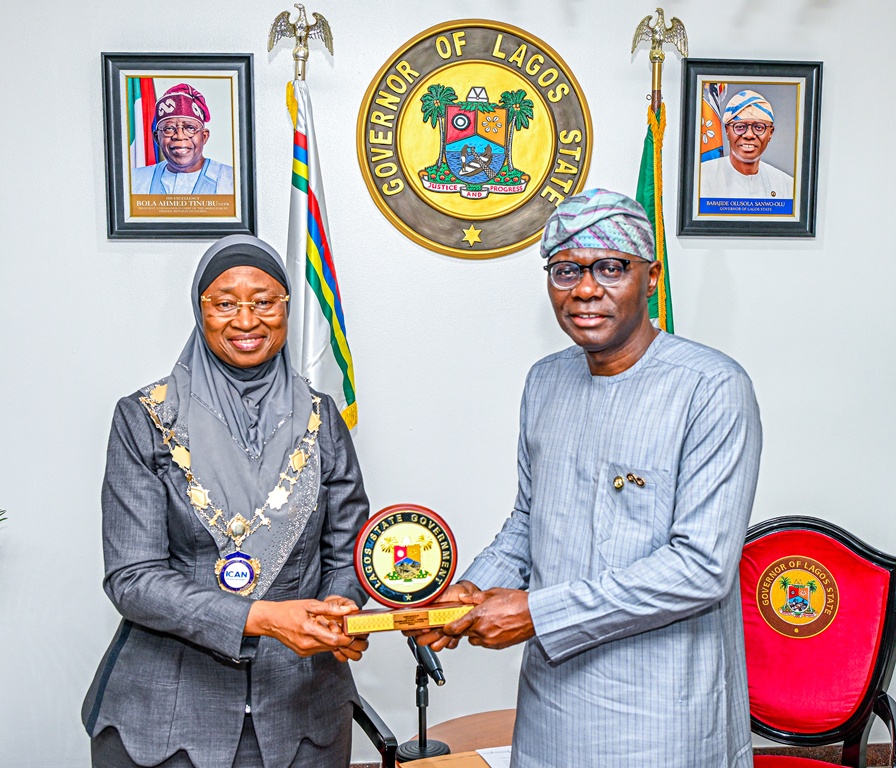
The Lagos State Governor, Babajide Sanwo-Olu, has charged accountants to take more active roles in policymaking and governance, saying their expertise could help strengthen institutions and improve public accountability.
Sanwo-Olu said this at the Lagos House, Marina, when he received the Governing Council and leadership of the Institute of Chartered Accountants of Nigeria (ICAN), led by its 62nd President and Chairman of Council, Queensley Seghosime.
The Governor said his administration had consistently engaged professional bodies, particularly ICAN, to strengthen financial management, internal controls, auditing and accountability across the state public service.
He noted that Lagos had a large pool of professional accountants within its public service, describing them as strategic partners in the state’s efforts to promote sound financial governance.
According to him, the vision of his administration aligns with ICAN’s objective of promoting better government, a stronger business environment and strategic partnerships that would improve the quality of governance.
Sanwo-Olu also welcomed ICAN’s Accountability Index, describing it as a timely initiative that could help identify gaps, strengthen institutional capacity and use the accountancy profession as a tool for improving governance.
He urged accountants to move beyond merely analysing past financial records and become more visible in leadership and policymaking.
“Accountants too can indeed be real change makers. They can be policymakers, they can be policy initiators,” the governor said, urging professionals to be bold and take charge of responsibilities within government and other institutions.
Sanwo-Olu further disclosed that Lagos State would be well represented at ICAN’s forthcoming 56th Annual Accountants’ Conference, saying the state was already preparing to send a large delegation.
Earlier, the ICAN President, Queensley Seghosime, expressed appreciation to the governor for his support and longstanding relationship with the institute.
She described Lagos as Nigeria’s economic nerve centre and a reference point for sub-national governance, noting that developments in the state often have implications for the rest of the country.
Seghosime said ICAN was seeking a stronger and more strategic partnership with the Lagos State Government, offering the institute’s professional expertise to support public financial management, internal controls, audits, revenue accountability, sustainability reporting and capacity development across government ministries, departments and agencies.
She said the ICAN Accountability Index should not be viewed merely as a ranking system but as a diagnostic tool for identifying institutional strengths, gaps and opportunities for improvement.
The ICAN president therefore sought the governor’s support in providing information required for the assessment, with the goal of making Lagos a reference point for accountable sub-national governance in Africa.
She also appealed for Lagos State’s support for ICAN’s transition to electronic examinations, noting that the initiative would require significant investment in technology and digital infrastructure.
According to her, partnering with Lagos in the digital transformation would strengthen the professional examination system and ultimately improve the quality of accountants serving the state and the country.
Seghosime formally invited Governor Sanwo-Olu to the institute’s 56th Annual Accountants’ Conference scheduled for October 15 to 23, 2026, with the theme, “Beyond Numbers, Strengthening the Economy, Securing the Nation.”
She also sought the continued support and sponsorship of the Lagos State Government for the conference, as well as approval for accountants and other relevant financial professionals in the state public service to participate.
Seghosime said such participation should be viewed as an investment in the institutional capacity of the state.
She added that ICAN’s partnership with Lagos was aimed at strengthening institutions, deepening accountability and demonstrating the impact of collaboration between government and the accountancy profession.
