


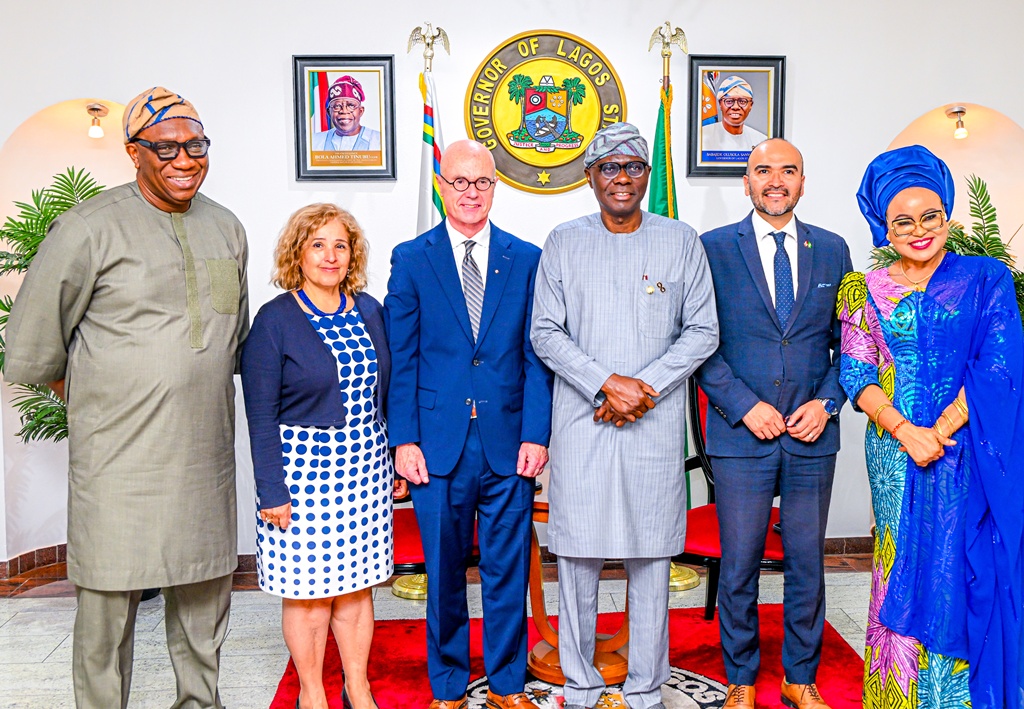
The Lagos State Government has called for stronger economic and investment ties between Nigeria and Canada, particularly in infrastructure, clean energy, agriculture, healthcare, mining and technology.
Governor Babajide Sanwo-Olu made the call at Lagos House, Marina, when he received the Canadian High Commissioner to Nigeria, Pasquale Salvaggio, who was accompanied by the Deputy High Commissioner, Carlos Rojas-Arbulu, on a courtesy visit.
The Governor said Lagos had maintained a productive relationship with Canadian diplomatic representatives over the past seven years, noting that the partnership had created opportunities for trade missions, investment and people-to-people exchanges.
He expressed optimism that the relationship could be deepened, stressing that Lagos, as Nigeria’s commercial and economic hub, remained open to increased Canadian investment.
Sanwo-Olu welcomed growing interest by Canadian businesses in Nigeria, particularly reports of Air Canada’s plans to strengthen its operations and potentially establish direct connectivity between Canada and Nigeria.
He said improved air connectivity would boost economic activity and strengthen ties with the large Nigerian diaspora in Canada, while also facilitating greater movement for business, education and tourism.
The Governor also highlighted the importance of concluding the proposed Foreign Investment Promotion and Protection Agreement between Nigeria and Canada, saying it would provide greater confidence and security for investors from both countries.
He urged the Federal Government to expedite the process, noting that the agreement was critical to attracting more Canadian investments into Lagos and Nigeria.
Sanwo-Olu identified infrastructure, clean technology, renewable energy, agri-food processing, logistics, food security and mining as areas with significant opportunities for collaboration.
He said Lagos was developing infrastructure and logistics hubs to support food processing, storage and distribution, while also pursuing renewable energy and other clean technology initiatives.
The Governor added that Canadian engineering and consulting firms had already played roles in infrastructure development in Nigeria, expressing readiness to expand such partnerships.
Earlier, High Commissioner Salvaggio said Canada considered Nigeria a natural partner and was committed to strengthening bilateral relations, particularly with Lagos.
He said Canada had recently developed a comprehensive Africa strategy aimed at prioritising key areas of engagement, with Nigeria at the top of its list.
Salvaggio said Canada had agreed to an amendment to its air transport agreement with Nigeria, describing it as a significant step toward improving people-to-people and economic ties between both countries.
He also expressed optimism that the long-standing Foreign Investment Protection agreement between Nigeria and Canada would soon be concluded, noting that it would provide additional assurances for investors at a time of growing commercial interest.
According to him, more than 30 Canadian companies participated in a trade mission to Lagos in June, describing the development as evidence of the rapidly expanding economic relationship.
He listed infrastructure, clean technology, agri-food, healthcare, mining services, financial services, ICT and innovation as key sectors where Canada was seeking stronger commercial cooperation with Nigeria.
The High Commissioner said bilateral trade was growing rapidly, although the balance currently favoured Nigeria, adding that Canada was interested in expanding trade to create greater benefits for both countries.
He also commended the Lagos State Government for its support to the Canadian Deputy High Commission and its officials, noting that the Canadian mission in Lagos was part of the city’s community and appreciated the assistance provided by the state government.
